







AI trading agents are taking crypto automation way beyond the traditional trading bot.
For years, traders have used bots to handle repetitive tasks.
Buy when Bitcoin reaches a certain price.
Sell when a target is hit.
Rebalance a portfolio every week.
Simple.
But what happens when you give software a broader goal instead of a fixed instruction?
Something like:
“Monitor my portfolio, watch the market, and keep my risk within these limits.”
Now the software needs to do more than follow one rule. It needs to gather information, interpret what’s happening, decide what action makes sense, and potentially execute it.
That’s the basic idea behind an AI trading agent.
And this isn’t purely theoretical anymore. In 2026, companies including Coinbase and MetaMask have launched infrastructure specifically designed to let AI agents interact with wallets and execute on-chain actions within defined controls.
But before you get excited about handing an AI your portfolio, there’s a lot to understand.
What Exactly Is an AI Trading Agent?

Let’s keep this simple.
An AI trading agent is software that can observe information, reason about a goal, use connected tools, and take actions toward that goal.
That’s what makes it different from a normal chatbot.
A chatbot might tell you:
“Bitcoin’s momentum looks bullish.”
An agent could potentially monitor Bitcoin, check relevant market data, evaluate your predefined rules, and, if you’ve given it permission, execute a trade.
The important word here is agent.
It’s not just answering you.
It’s acting on your behalf.
The level of autonomy depends on how the system is built and what permissions you’ve given it. Some agents may only research and recommend actions. Others can interact directly with wallets, exchanges or smart contracts.
Research published in 2026 mapped 306 crypto AI agents across areas including trading, portfolio management, governance and other applications, showing that the category has already expanded well beyond simple chatbots.
And that’s why AI agents are becoming such an interesting part of the crypto conversation.
AI Agents vs. Trading Bots: What’s the Difference?

These two terms get mixed together constantly.
They’re related, but they’re not quite the same thing.
A traditional trading bot usually follows a predefined set of rules.
For example:
If BTC falls 5%, buy $500.
The bot doesn’t need to understand why Bitcoin fell.
It checks the condition.
If the condition is true, it executes the instruction.
An AI agent can work with a broader objective.
For example:
“Manage my Bitcoin position while keeping my portfolio risk below this level.”
To do that, an agent could potentially look at price, volatility, portfolio exposure, market conditions and other information before deciding what action fits the objective.
So think of it this way:
A bot follows a recipe.
An agent works toward an outcome.
That flexibility is powerful.
But it also introduces a new problem.
The more freedom you give software, the more carefully you need to control what it can do.
How Do AI Trading Agents Actually Work?
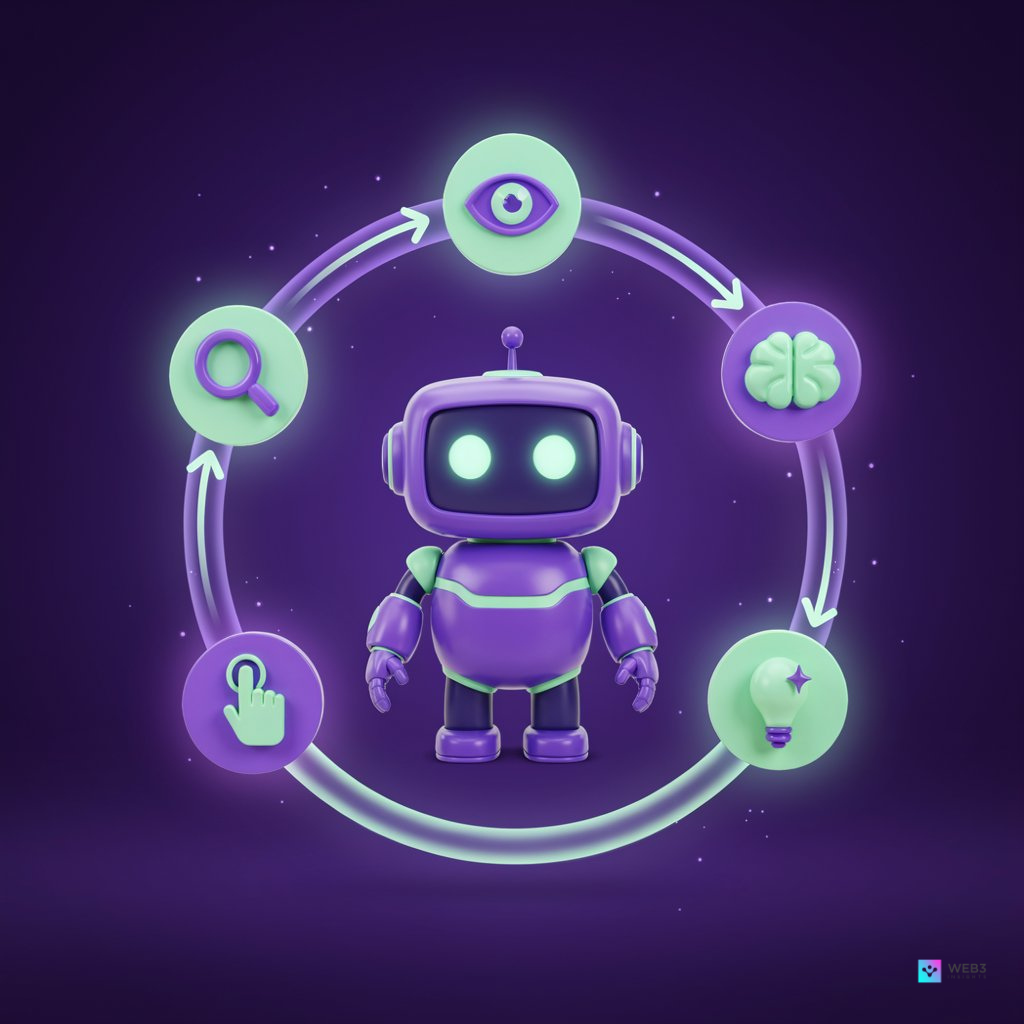
Under the hood, an AI trading agent is more than just an AI model.
It needs a few different pieces working together.
First comes the data.
The agent might monitor price, volume, market sentiment, on-chain activity, liquidity, funding rates, news or your own portfolio.
Then comes the AI model, which interprets that information and reasons about the task you’ve given it.
But reasoning isn’t enough.
The agent also needs tools.
Those tools might connect it to a crypto exchange, blockchain network, wallet, decentralized exchange or market-data platform.
Finally, there’s execution.
If the agent has the right permissions, it can take an action, such as placing a trade, swapping tokens, rebalancing a portfolio or interacting with a DeFi protocol.
That’s where crypto becomes particularly interesting.
Coinbase’s Agentic Wallet infrastructure, for example, is designed to give agents capabilities such as sending, trading and earning, while its Coinbase for Agents product lets connected agents trade and pay within user-controlled limits.
MetaMask has also built an Agent Wallet that lets users define spending limits, protocol allowlists and risk preferences before agents execute supported on-chain actions.
The basic loop is:
Observe → Analyze → Decide → Act → Monitor
And then repeat.
That’s a big step beyond a bot checking whether one price condition has been met.
What Can AI Trading Agents Actually Do?

This is where things get interesting.
An AI trading agent doesn’t necessarily have to spend all day buying and selling Bitcoin.
Depending on its permissions and the infrastructure it’s connected to, it can potentially handle several parts of the crypto workflow.
1. Monitor markets
An agent can continuously watch prices, volatility, liquidity and other market signals instead of waiting for you to open a chart.
2. Analyze opportunities
It can process multiple sources of information and identify situations that deserve a closer look.
3. Manage portfolios
An agent could monitor your allocations and rebalance them according to rules you’ve established.
4. Interact with DeFi
Agents can potentially interact with decentralized exchanges, lending protocols, perpetual markets and other smart-contract applications.
5. Handle payments
This is one of the more interesting developments.
AI agents don’t just need to trade. They may eventually need to pay for data, computing resources, APIs and other digital services.
Crypto gives software a programmable way to do that.
And that’s why the bigger story isn’t really “AI trading bots.”
It’s software becoming capable of interacting with financial infrastructure.
Coinbase describes this broader shift as agents becoming able to trade, pay and operate workflows on behalf of users, while MetaMask’s current Agent Wallet supports agent-driven on-chain actions within user-defined controls.
We’re moving toward software that doesn’t just give instructions.
It can actually do things.
Trader’s Take
AI trading agents are interesting because they’re changing what we mean by automated trading.
A traditional bot follows rules.
An AI agent can interpret information, work toward an objective and potentially take multiple actions to achieve it.
That could eventually make crypto trading and investing far more automated.
But there’s a trade-off.
The more autonomy you give software, the more responsibility you have to control what it can do.
So don’t rush to give an AI unrestricted access to your money just because the technology looks impressive.
Start small.
Set boundaries.
Watch what it does.
And remember:
An AI agent can execute a strategy. It doesn’t automatically make that strategy a good one.