





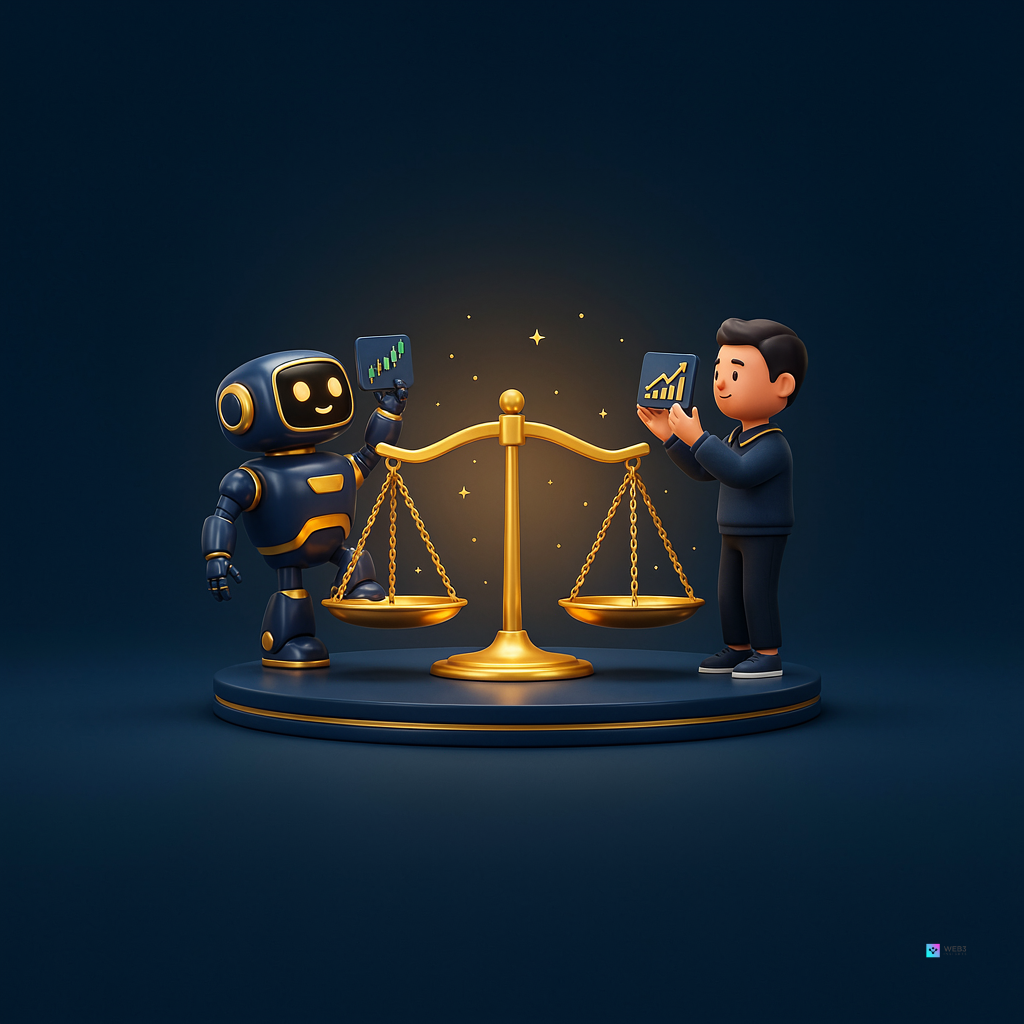
AI vs human traders is becoming a much more interesting question as artificial intelligence moves from being a research tool to something that can actually analyze markets, generate strategies, and in some cases execute trades.
For years, the debate was mostly theoretical.
Now AI systems can process huge amounts of information, identify patterns, analyze news, monitor markets around the clock, and execute decisions without getting tired.
Humans, meanwhile, have something AI still struggles with: judgment.
That makes the real question less about whether AI or humans are “better.”
It’s about which parts of trading should be handled by AI and which still require a human brain.
And the answer is more nuanced than either side of the AI hype would suggest.
1. Where AI Has the Biggest Advantage
Let’s start with the obvious one: speed and information processing.
A human trader can follow a handful of markets closely.
An AI system can potentially monitor thousands of assets, news sources, indicators, order-book signals, and other data points simultaneously.
That’s a completely different scale of analysis.
AI also doesn’t need to sleep.
It doesn’t get bored after staring at charts for six hours.
And it doesn’t suddenly decide to abandon a trading plan because it just took three losses in a row.
That matters.
Human traders are vulnerable to emotional and behavioral biases. Research on professional day traders, for example, has found that humans can display the disposition effect; holding losing positions while selling winners, while algorithmic traders show substantially less of this behavior.
AI can also be extremely consistent once a strategy and its rules are defined.
If the system is told:
“Only enter when these five conditions are met.”
it doesn’t wake up one morning and decide:
“You know what? Bitcoin looks different today. I’m feeling bullish.”
That’s an advantage.
AI is particularly useful for:
- Processing large amounts of market data
- Monitoring multiple markets simultaneously
- Finding statistical patterns
- Screening assets
- Summarizing news and research
- Running repetitive analysis
- Maintaining consistent rules
- Executing predefined strategies quickly
This is one reason AI and algorithmic trading continue to attract serious attention from professional investors.
But there’s a catch.
Being able to process more information doesn’t automatically mean making better decisions.
2. Where Human Traders Still Have the Edge
Markets aren’t spreadsheets.
They’re constantly changing environments shaped by economics, politics, psychology, liquidity, narratives, regulation, and sometimes pure chaos.
That’s where human judgment becomes difficult to replace.
Imagine Bitcoin suddenly drops 12% because of a geopolitical event.
An AI model trained primarily on historical market relationships may recognize similar price patterns.
But a human can ask a different question:
“Is this actually comparable to previous events?”
That’s important.
Historical data is useful, but the future doesn’t have to behave like the past.
Research into AI trading has repeatedly highlighted this problem. A 2025–2026 research paper on the limits of AI trading argues that even powerful autonomous learning systems aren’t guaranteed to dominate humans in competitive markets because their performance depends heavily on the information structure and sophistication of the market.
Humans can also incorporate things that are difficult to quantify.
For example:
- A sudden change in political rhetoric
- A new regulatory direction
- A shift in investor psychology
- Whether a market narrative feels overcrowded
- Whether an unusual event is genuinely unprecedented
- Whether the data itself can be trusted
None of this means humans are naturally better traders.
Far from it.
Humans are emotional, inconsistent, impatient, and extremely good at convincing themselves that a bad trade was actually a “long-term thesis.”
But human judgment can still be valuable when the environment changes faster than a model’s assumptions.
3. AI Can Be Powerful Without Being a Better Trader
This is where the debate gets interesting.
AI doesn’t necessarily need to beat humans at everything to be extremely useful.
Think about what happens before you place a trade.
You might need to:
- Find the asset.
- Research the narrative.
- Check recent news.
- Analyze the chart.
- Examine liquidity.
- Look at derivatives data.
- Review on-chain activity.
- Develop a thesis.
- Challenge the thesis.
- Decide where the trade becomes invalid.
That’s a lot of work.
AI can help with several of those steps.
And that’s probably one of the most practical ways traders should think about AI today.
Instead of:
“AI, tell me what to buy.”
Try:
“AI, help me research this opportunity.”
There’s a huge difference.
You remain responsible for the final decision while using AI as a research and analysis layer.
In fact, an experiment published in Review of Finance found that participants who combined manual trading with automated trading robots earned more than participants relying only on manual trading in the experiment.
That’s a useful way to think about the future.
Human + machine doesn’t necessarily mean human versus machine.
4. The Biggest Problem With AI Trading

The biggest mistake traders can make is assuming that because AI sounds intelligent, its decisions must be intelligent.
They’re not the same thing.
AI can produce a beautifully structured explanation for a terrible trade.
It can identify a pattern that doesn’t actually matter, misinterpret data, use outdated information, or overfit historical relationships.
And if an autonomous system is given permission to trade, a mistake can move from “bad analysis” to real financial loss very quickly.
This is one reason human oversight remains important.
Regulators have also highlighted concerns around AI in financial markets, including model governance, black-box decision-making, investor vulnerability, and systemic risks.
There’s another problem: everyone can use the same technology.
If thousands of traders use similar AI systems trained on similar information, their decisions could become more correlated.
Instead of reducing market volatility, widespread automation could potentially amplify certain market movements.
Recent research on autonomous AI traders has produced mixed results. A 2026 experimental-market study found that an autonomous AI trader consistently outperformed human traders in its specific experimental setting, but found no improvement in overall market efficiency.
That’s important because it shows why one impressive AI result shouldn’t be interpreted as:
“AI has officially beaten humans.”
Different models, markets, datasets, timeframes, and rules can produce completely different outcomes.
There is no universal “AI trader.”
5. So Who Actually Makes Better Trading Decisions?
The honest answer?
It depends on the decision:
- Let’s say the job is processing enormous amounts of structured information quickly, AI has an obvious advantage.
- If the job is executing a predefined strategy consistently without emotional interference, AI has an advantage again.
- If the job is researching hundreds of assets, AI can dramatically reduce the workload.
But when the environment changes unexpectedly, when information is incomplete, or when the problem requires judgment rather than pattern recognition, humans still have an important role.
And that’s why the most interesting model isn’t really:
AI vs Human.
It’s:
AI + Human.
Imagine a trader who uses AI to scan the entire crypto market, identify unusual activity, summarize relevant news, analyze technical structures, and challenge their thesis.
The trader then decides whether the opportunity actually makes sense.
AI handles the scale.
The human handles the judgment.
That combination is far more interesting than simply handing your account to a bot and hoping for the best.
The future of trading may not belong to traders who completely reject AI.
It may also not belong to traders who blindly hand everything over to it.
It may belong to traders who understand where the machine is better, and where the human needs to stay in the loop.
Trader’s Take
The AI vs human traders debate is asking the wrong question if it assumes only one side can win.
AI is incredibly good at things humans are bad at: speed, scale, consistency, repetitive analysis, and processing huge amounts of information.
Humans are good at things that are harder to reduce to rules: judgment, context, adapting to genuinely new situations, and understanding why something may be happening rather than simply recognizing that it happened before.
Neither side is perfect.
And that’s actually the opportunity.
Use AI to remove the boring parts of trading.
Use it to research faster, challenge your assumptions, analyze data, and expose things you might have missed.
But don’t confuse a confident AI response with certainty.
The strongest trader may not be the one who chooses AI over humans.
It may be the one who knows how to make both work together.